



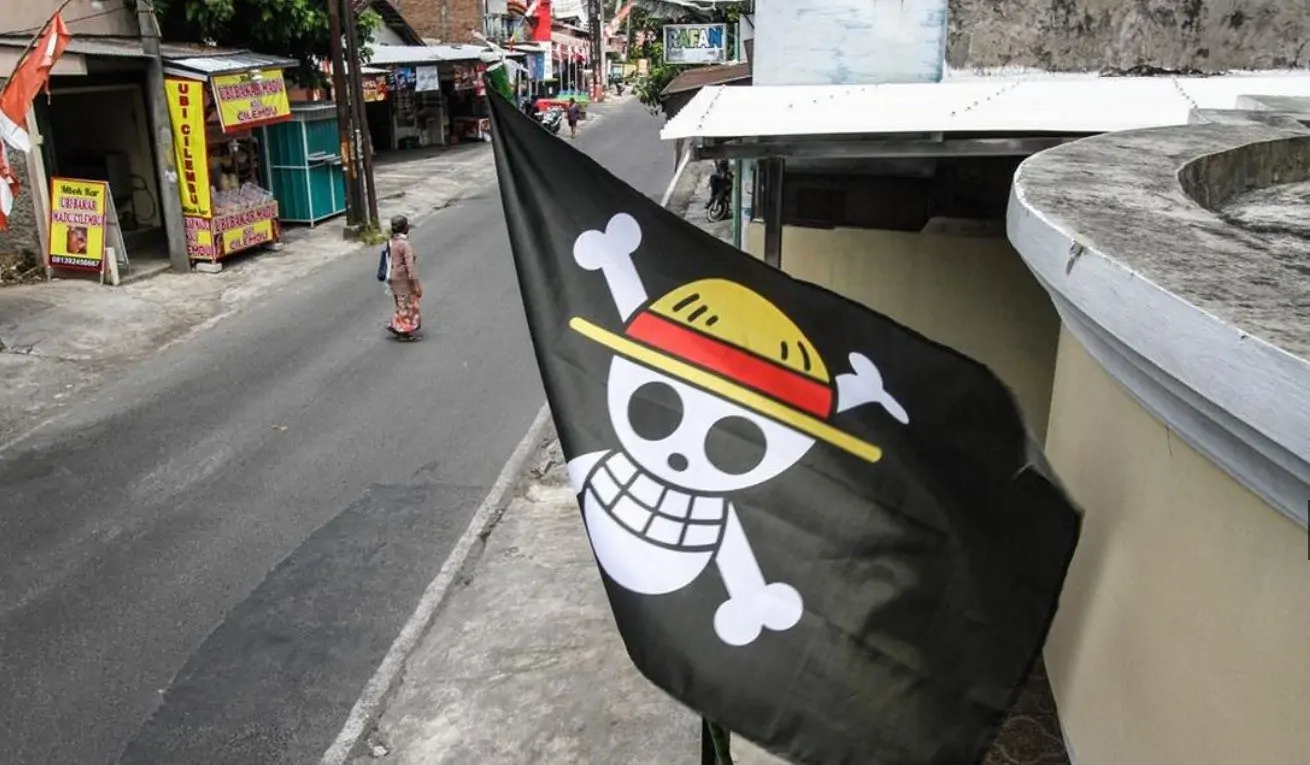
This year, “Agustusan”–Indonesia’s independence day celebrations–may feel a bit different. Not because there are no “panjat pinang” (pole-climbing) or “balap karung” (sack races) like we experienced during the pandemic, but because of the surge in social media posts showing that instead of waving the Indonesian flag, some people are displaying a pirate flag, commonly known as the “jolly roger,” with a straw hat, a symbol worn by Monkey D. Luffy in the “One Piece” anime.
At a glance, fans of this anime can immediately detect the meaning of this action as a form of resistance against government corruption, injustice, arbitrariness, and other issues. If these fans agree with this narrative, perhaps they will do the same as a show of support.
The question is, where is the context of Luffy, a young man who dreams of becoming a pirate, relevant to our society? So, does posting or waving the jolly roger on social media automatically represent a pirate’s passion? Pirates without a conscience?
Starting from X
In the domain of culture and digital communication studies, there is the term social network analysis (SNA) as a method for tracking out how issues, trends, discourse or narration arise and how it has a shift. Drone Emprit is one of them.
In recent weeks, the Drone Emprit reported around 15,000 posts related to One Piece on various social media platforms, mostly in X with tens of thousands of posts and more than 2 billion engagement. Similarly, in Tiktok which records hundreds of posts on several for you page (FYP) and gives birth to more than one hundred million engagement.
This original Indonesian SNA software recorded that the idea of raising the “One Piece” flag appeared first on July 26, 2025 on an X account when commented on the 80th Indonesian Independence Day logo quality released by the government. Initially, one X user commented that he would fly the Dutch flag to mark the failure of the Indonesian government–of course related to the selection of the logo. Other users then chimed in that he would fly the Japanese flag. Then, other users commented that he would fly the One Piece flag as a joke.
It is important to note that this comment was originally a joke to respond to the 80th Indonesian Independence Day logo release which later gave birth to a new narrative that the logo was very similar to the character “Keroppi” or “Gorilla” or even other narratives. It is very natural when later this joke comment actually triggers actions that are interpreted as resistance to power.
Even so, the invitation or call to raise the One Piece flag cannot just be interpreted as an act of desacralization or blasphemy on the Indonesian flag because it even appeared long before the call to raise the flag that has become a tradition of Indonesian citizens every August arrives.
Furthermore, as a social media, X is a platform that provides space where each user can express his view as part of the participatory culture that may give birth to certain narration. As reminded by Jenkins (2006), narratives on social media often appear in layers and uncontrollable, even possible different from the narrative referred to by the main narrative.
Jolly Roger with Straw Hats
It is also important to note that Jolly Roger version of “One Piece” is fundamentally different from Jolly Roger used by pirate groups in the real world. Jolly Roger generally refers to the symbol of “Skull and Crossbones” with a black background and has been used since the 1710s with a general meaning referring to death or something dangerous. In a modern context, this symbol is then adopted for warnings of everything that is dangerous, threatening, or pinned on pirated products.
Meanwhile, Luffy has a visually different flag. Instead of using a scary skull image, he and his group modify the skull image by adding a straw hat. Of course, this straw hat is an attribute that is narrated as something of ideological and emotional value.
This iconic straw hat has an ideological value because it is narrated as a symbol of freedom and emotional value because he got it from one of his most influential mentors, namely the character of the Red Hair Shanks. This figure motivated Luffy to navigate the ocean and fight the evil pirates or unfair rulers. Shanks even gave this straw hat as a motivation for Luffy to return it later to Shanks and that’s when Luffy will be recognized as a true pirate.
Netizens as “Nakama”
“Political” jokes by referring to the imaginative character among Indonesian netizens are certainly not new. Even the term “Negeri Konoha” has long been used by Indonesian netizens when complaining about various public problems. They love this country too much to call Indonesia a place of various problems and social inequality. Then they use these semiotic nuances while hoping that the administators of the country will improve.
In the case of raising the Jolly Roger flag, we are lucky to be hoisted or called by netizens, not the real Jolly Roger. Because, Jolly Roger with a straw hat used by Luffy, in the analysis of Baudrillard (1996) is actually a form of simulacra or copy-of-copy-of-reality, which is a fiction from the sign previously referred to by Jolly Roger in real reality as something deadly, cruel, against the law, and not in humanity.
The presence of the Straw Hat as part of the One Piece version of Jolly Roger is an important sign that leads to a new meaning that pirates imagined by Luffy are different from pirates in general–which he actually fights. This is what makes his fans so captivated by his hilarious behavior, dare to fight tyranny, sometimes reckless, spontaneous, but honest and loyal friends.
Furthermore, social media has expanded the reach of One Piece fans who were originally only dominated by anime fans. In other words, Indonesian netizens are now dominated by “Nakama”, the term for One Piece fans. Even though it might be part of the FOMO phenomenon, which they are DC or Marvel fans in the real world have significant differences.
Apart from that, this is a picture of digital culture where all instruments that appear digitally can be born in almost unlimited variations. Easy to modify, recycled, and presented again in different formats. In other words, a more in-depth analysis is needed to interpret everything that appears in a digital context.(*)
Author: Moch Fakhruroji (CDiCS, Researcher)
Originally posted in Mayantara Channel of AyoBandung.id in Bahasa Indonesia. Translation and re-publication of this material has been permitted by AyoBandung.id