

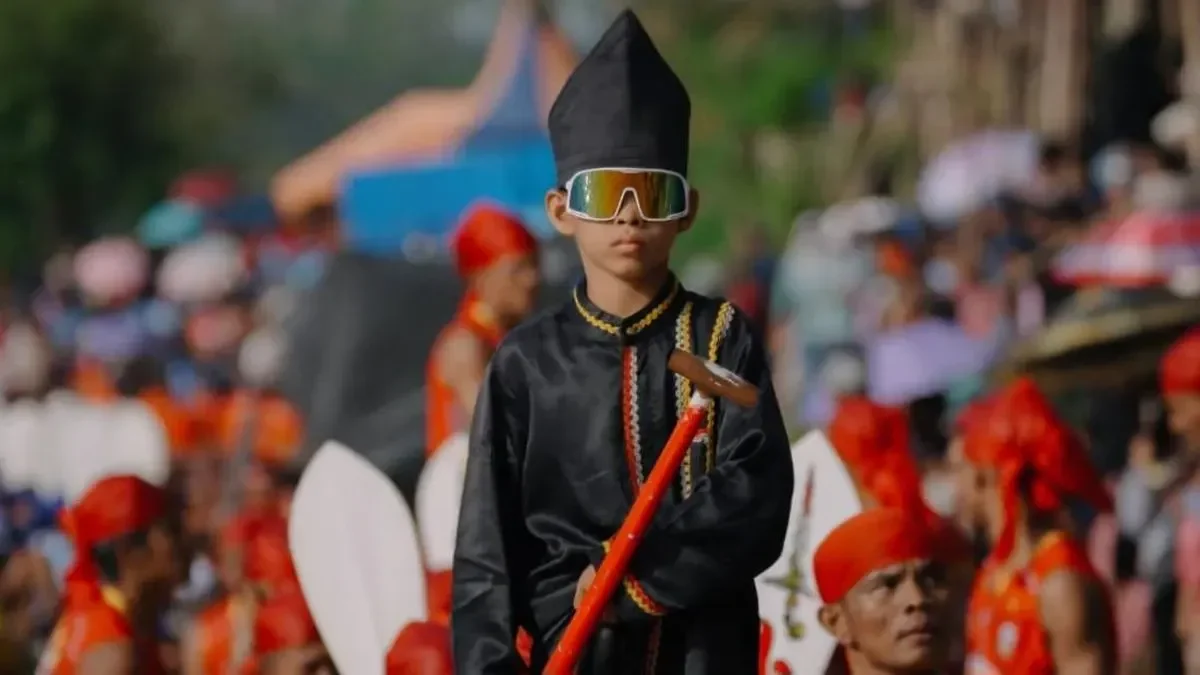
Who would have thought that a traditional Indonesian event that has existed since the 17th century would suddenly become known worldwide? This is what has been happening in recent weeks. An 11-year-old boy named Rayyan Arkhan Dikha from Riau Province has suddenly gone viral on social media.
Wearing traditional black clothing and sunglasses, Dika—as he is affectionately known—captured the attention of millions of social media users worldwide as he “danced” on the edge of a rowing boat during the Pacu Jalur event, a traditional cultural event in Kuantan Singingi, a regency in Riau Province.
Pacu Jalur itself is a tradition that has existed since the 17th century and has become part of Indonesia’s rich cultural heritage. In this event, each long canoe-like boat is accompanied by an “anak coki” who “dances” on the edge of the rowing boat, rhythmically moving his hands and body to encourage and direct the movements of the rowers.
This video was actually first posted on TikTok by a user with the account Lensa Rams last January. In fact, the video was taken in August of the previous year. However, the video has gone viral in recent weeks after his unique dance was imitated by social media users on Instagram and TikTok.
Aura Farming
The popularity of this traditional dance by Dika, the “anak coki,” is one illustration of the phenomenon of “aura farming.” This term, which became popular in 2024, refers to an internet expression usually directed at celebrities or anime characters for being “cool” and harvesting “aura.”
Dika’s traditional black outfit, complete with black sunglasses—reminiscent of Men in Black, a popular Hollywood movie—is seen as “the ultimate aura farmer” on social media. Not only does he look cool, but Dika also looks unwavering even while standing on a fast-moving boat. This is what seems to have amazed people. His unique moves have flooded social media timelines not only in Indonesia but also around the world.
Theoretically, aura farming is a phenomenon that illustrates how meaning is constructed and circulated by social media users, rather than by hierarchical power structures. All internet users are interconnected nodes—connected points that form what Manuel Castells calls a “network society.”
Local with global reach
It’s almost certain that Dika didn’t intend to “spread charm” or “harvest aura” through his performance, and perhaps for him, it was part of the Pacu Jalur event. After all, he has been an “anak coki” since he was 9 years old. However, social media users are a society that practices digital culture, where every unique practice can be recreated and shared with other social media users.
At this point, digital culture illustrates how content creators can reproduce previous content in new ways and contexts, yet coexist and enhance each other. However, one thing is certain: now it’s not just Dika who’s captivating the world, but also Pacu Jalur, a uniquely Indonesian local tradition.
Therefore, it seems timely that the Governor of Riau appointed Dika as the province’s Tourism Ambassador and awarded him a scholarship, indirectly introducing Pacu Jalur and Riau to the world. As of this publication, Pacu Jalur remains a trending topic on various social media platforms. Not only on social media, but Dika has also been featured in mainstream media as the “viral Indonesian boy.”
This phenomenon is one of the most striking illustrations of how cultural flows in the digital context have had a broader impact. Moreover, Dika is neither the first nor the only figure to achieve digital popularity.
The popularity of Pacu Jalur and Riau Province on social media is evidence that the internet has become a gateway for local traditions to gain global recognition.
Although both had previously been promoted in local and perhaps national mainstream media, this momentum was gained through social media. Media has become a platform for individual and personal expression, something Manuel Castells (The Rise of the Network Society, 1996) described as “networked individualism.”
This also demonstrates that social media platforms have once again demonstrated their participatory nature. The internet has provided equal opportunities for every cultural group to emerge as a current on the global stage, regardless of their interests and goals. (*)
Author: Prof. Dr. Moch Fakhruroji (CDiCS, Director, Researcher)
Originally posted in Mayantara Channel of AyoBandung.id in Bahasa Indonesia. Translation and re-publication of this material has been permitted by AyoBandung.id