

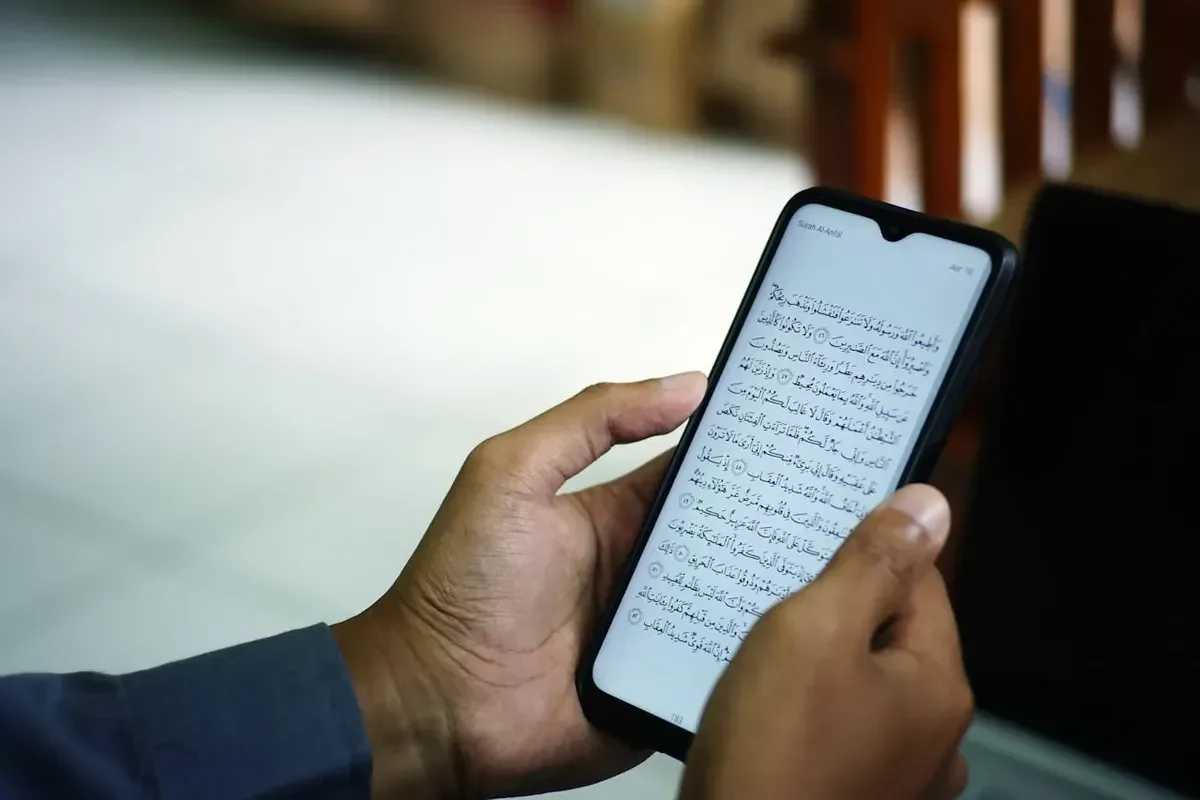
In an era when many public spaces have shifted to the digital realm, some young Muslims are choosing a quiet path that is becoming increasingly crowded. They gather not in mosque halls or campus halls, but around WhatsApp notifications that buzz all night long.
One such group is the Kopdar Masjid Bandung Raya community, a place where da’wa no longer takes the form of one-way lectures, but rather a dialogue that continues to grow from screen to action.
This WhatsApp group has become a hub. They don’t just share links to Islamic studies or send Islamic stickers, but also plan concrete social projects.
They distribute da’wa posters, provide funding for new converts who regularly attend Sunday morning guidance, distribute 62,000 food packages to encourage congregational iftar (Islamic fasting break), and even donate to animals at the Bandung Zoo, which has struggled due to the pandemic. All of this stems from a single principle: faith needs to be realized in actions, not just narratives.
There is no rigid organizational structure. There are no committees printed on billboards, yet every movement feels organized. Collaboration exists between mosque activists from across Greater Bandung, West Java.
One group designed the materials, another designed posters, someone managed the logistics, and still others secretly transferred the donations. Everything was done with a shared passion: making technology a space for charity, not just a communication channel.
The activists also realized that not everyone was suited to the mass preaching style. So they chose a different approach: a series of systematic, empathetic movements.
One example is the 24-episode study of Ummahatul Mukminin, which was broadcast on the YouTube channel of the Arrahman DKM, West Bandung Regency, and gradually disseminated in various WhatsApp groups. Some listened while waiting for the train, others while washing the dishes.
What happened in this community can be read as a form of what Quintan Wiktorowicz (2004) calls Islamic activism. It is not simply religious fervor, but a collective action rooted in ideological awareness, social concern, and network structure.
In activism, Islam is not only taught but also practiced communally, responding to the challenges of the times through measured and connected work.
Wiktorowicz emphasized that Islamic activism rests on three foundations: a deeply held idea, an organized community, and collective action. The Kopdar Masjid BDG Raya community fulfills all three.
They create a fresh religious narrative based on religious principles, organize themselves in an inclusive digital space, and put their teachings into practice through tangible solidarity. This is where religion lives in its most authentic form: as a driving force and a unifying force in social life.
In another perspective, this could also be called a form of cultural resistance, specifically how today’s young Muslims negotiate their identities amidst an era of distraction. The WhatsApp group serves as a bridge between mosques, a link between activists, and a space that connects good intentions with concrete action.
But like all digital spaces, it also carries the potential for bias. Not all circulating narratives are validated, and not all religious teachers possess strong scholarly authority. But this is where the dynamic becomes a reflection, rather than a boundless distortion.
New Media, New Pulpit
Jeff Zaleski (1997), in his landmark work, “The Soul of Cyberspace: How New Technology Is Changing Our Spiritual Lives” wrote, “cyberspace is not just a tool, but a realm where spiritual experiences are increasingly mediated and shaped.”
This means that digital space is not just a channel, but also a new altar where people seek meaning. And that is precisely what is happening in this WhatsApp group: the phone screen becomes a silent space that presents God in a form that can be replayed, resented, and individually contemplated.
The virtual world not only conveys messages, but shapes inner experiences, enabling people to experience the search for meaning in a limitless space.
What was once only possible in halaqahs or pioneering Islamic organizations has now moved to WhatsApp, Telegram, or YouTube. And in them, faith has not lost its vitality; instead, it has found new ways to grow.
Of course, not everyone immediately accepted this method of preaching. Some long-standing mosque administrators considered it a break from tradition. But these young people didn’t come to fight; they came to patch up the rifts.
They also offered a more adaptive approach without severing their roots, as they embraced the changing times by transforming the screen into a calm yet concrete platform for da’wa.
In this community, no voice is higher than another. Everyone can be a driving force, and every idea can become a program. WhatsApp became a fluid space for discussion and a place to strengthen and remind each other.
This is where the idea arose to schedule da’wa trips to outlying areas like Gambung and Naringgul, on the border between Bandung and Cianjur Regencies. Even financial reports of these activities are shared openly to build trust. For them, hijrah (migration) isn’t simply a shift from the old to the new. It’s the courage to build a faith ecosystem that is truly active and relevant to the times.
And when this space is successfully created on the devices we hold every day, it’s no exaggeration to believe that Allah is now “present” not merely behind the pulpit. But also in messages typed slowly on a cell phone screen, then sent with the request to be read carefully, which moves people to take collective action. (*)
Author: Muhammad Sufyan Abd. (CDiCS, Communication Officer, Researcher)
Originally posted in Mayantara Channel of AyoBandung.id in Bahasa Indonesia. Translation and re-publication of this material has been permitted by AyoBandung.id